.png?width=1200&height=628&name=AK_Blog%20Images%20(21).png)
Every January brings a familiar mix of pressure and possibility. Deadlines restart, clients return from holidays with new expectations, and teams settle back into their daily rhythm. It is also the one time of year when firms have a natural pause between cycles.
That shift in pace creates an opportunity that many practices overlook. The new year is the best moment to reset your systems and rebuild the structure that carries your team through the next twelve months.
Firms often talk about wanting cleaner workflows, fewer errors, and a more coordinated team. Those improvements do not happen by accident.
They come from taking a systems-first approach. When firms use the first few weeks of the year to rethink how their work moves, the benefits compound for months and years to come.
This blog explores why January is the ideal time to reset, what mistakes hold firms back, and how AccountKit fits into a more modern, structured way of running your practice.
The case for a systems reset every January
Accounting practices operate within a cycle. Even if you have continuous deadlines, the quiet early weeks of January create a natural reset point. Firms have a brief window before the real pace of the year returns. That window is valuable because several things shift at once.
- Client demands change.
Clients often come into the new year with revised goals, new entities, or updated expectations. A system reset ensures you can meet those expectations without scrambling. - Teams shift.
January is a common time for role changes, new hires, and returning staff who have had time to reflect on how they work. Updating your systems now gives people a clean starting point rather than forcing them to adapt mid-year. - Compliance updates arrive.
Changes in reporting requirements, guidance from regulators, and process adjustments from software providers all tend to surface around the turn of the year. Aligning your systems with these updates prevents last-minute fixes when deadlines hit later. - New tech is available.
Many practices adopt new tools or integrations at the start of the year. Consolidating systems in January gives you the best chance of creating a cohesive workflow rather than layering new tools over old habits. - And most importantly, the pressure is lower.
Trying to rebuild systems in April or October is significantly harder. January gives you breathing room to step back, review, and redesign without the weight of peak season. It is the right moment to make changes that stick.
The mistakes firms make when starting the year
Even though January offers the perfect chance to reset, many firms fall into predictable traps.
- They patch last year’s processes instead of redesigning them.
It is tempting to take an old process and adjust it slightly. The problem is that the issues that appeared last year often reappear because the system itself never changed. - They rely on memory, not structure.
When people return from the break, they tend to fall back on habit. Without documented instructions, checklists, and clear workflows, every team member works slightly differently. Small inconsistencies create bigger issues as the year progresses. - Workflow creep builds up.
What begins as a temporary workaround often becomes the default process. Tools get added without revisiting the overall structure. Tasks get shifted or duplicated. The workflow becomes harder to follow and even harder to train. - Tools remain siloed.
Many firms juggle multiple systems that do not talk to each other. This leads to lost time, confusion, and constant tab switching. Without a deliberate plan to bring tools together, the workflow never feels cohesive. - Responsibilities are unclear.
As roles evolve, handovers and task ownership often lag behind. Without clear definitions, work gets delayed or repeated. Junior staff struggle to understand where work sits at any point in time.
These mistakes pile up quietly. January is the time to fix them before they shape the rest of the year.
What a modern accounting system should prioritise
If you want a system that supports your practice throughout the year, it needs to be built around a few core principles.
- Visibility
Every team member should be able to see what is happening and where work is up to. No guessing. No searching. No relying on memory. - Repeatability
Processes should be consistent so that the same task is completed the same way every time. This reduces errors, improves training, and creates a predictable client experience. - Automation where it fits
Automation should remove repetitive work, not complicate the workflow. When used correctly, it takes care of routine tasks so your team can stay focused on the work that requires judgment and expertise. - Centralised knowledge
Templates, notes, documents, instructions, correspondence, and client information need to live in one place rather than scattered across inboxes and spreadsheets. - Ease of collaboration
Teams work better when the system itself enables collaboration. That means clear task ownership, shared visibility, and simple communication. - A strong client communication trail
Knowing what was sent, when it was sent, and where files live is essential for maintaining trust and staying compliant.
When your system prioritises these elements, everything becomes easier. Workflows move smoothly, errors drop, and the team feels more in control.
How to audit your current systems
Before you rebuild anything, you need a clear picture of what is and is not working. A simple internal audit gives you that clarity. You can start by asking a few practical questions.
- Are your processes documented?
If the answer depends on the memory of one or two people, the process is at risk. - Do you know where every job is at?
If the only way to find out is to ask someone or check five different screens, visibility is missing. - Does your team jump between too many tools?
Tool switching creates friction. The more scattered your workflow is, the more errors and delays appear. - Do you lose track of client interactions?
If notes and emails live in separate places, the communication trail weakens. - Can juniors work independently with clarity?
If they cannot, the system is not doing enough of the work.
This audit does not need to be complicated. The goal is to identify bottlenecks and confusion early so you can correct them before the year becomes busier. Even if it means simply picking one area to evolve, this will give you some momentum ready to do the next area when the end of finacial year comes around.
How AccountKit fits into a systems first approach
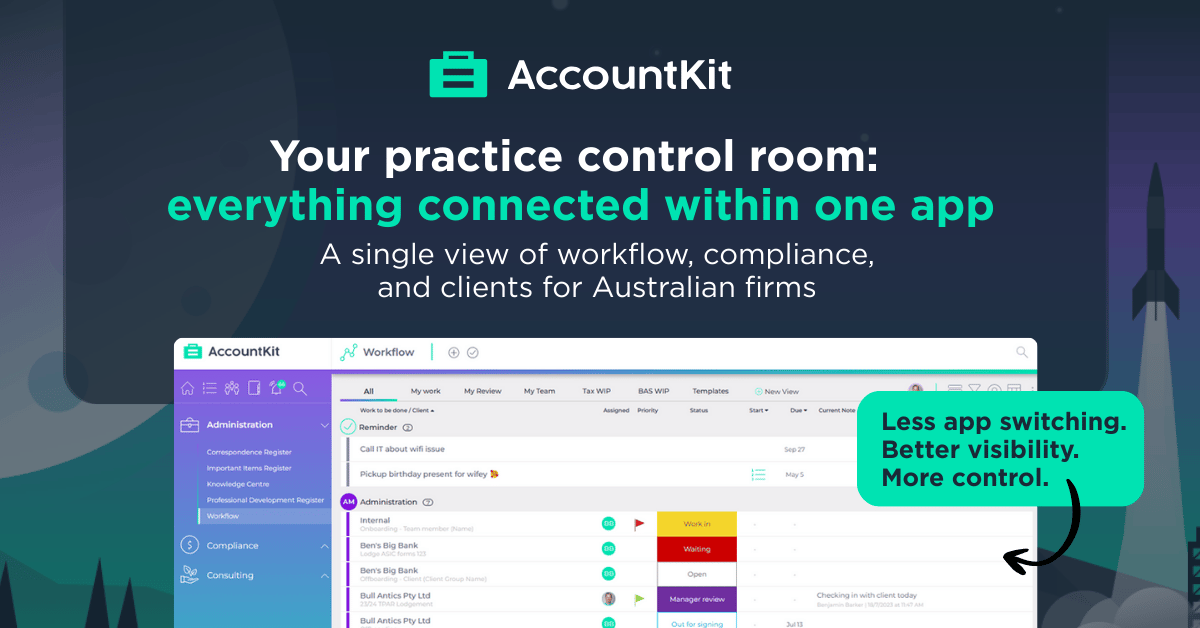
AccountKit is built for firms that want structure, clarity, and connection across their tools. Instead of juggling multiple systems and workarounds, firms use AccountKit to bring their workflow, client information, registers, and correspondence into one coherent view.
- Workflow becomes standardised.
Tasks follow a predictable path. Teams can see ownership, deadlines, and progress without digging. - Client information stays tidy.
Registers like equipment finance, inter entity loans, prepayments, and amortisation schedules keep client data clean and complete. - Tools remove repetitive work.
Automated schedules, posting, document handling, and tracking eliminate hours of manual administration that usually creeps into daily work. - Client structure and correspondence are always visible.
The client map and correspondence tools give teams a clear picture of relationships and communication without jumping across platforms. - Integrations reduce context switching.
Document management, practice apps, e signing, and other tools connect directly, so your team stays in one place instead of managing ten different systems.
This is what a systems first approach looks like in practice.
A simple 30-day plan to overhaul your practice systems
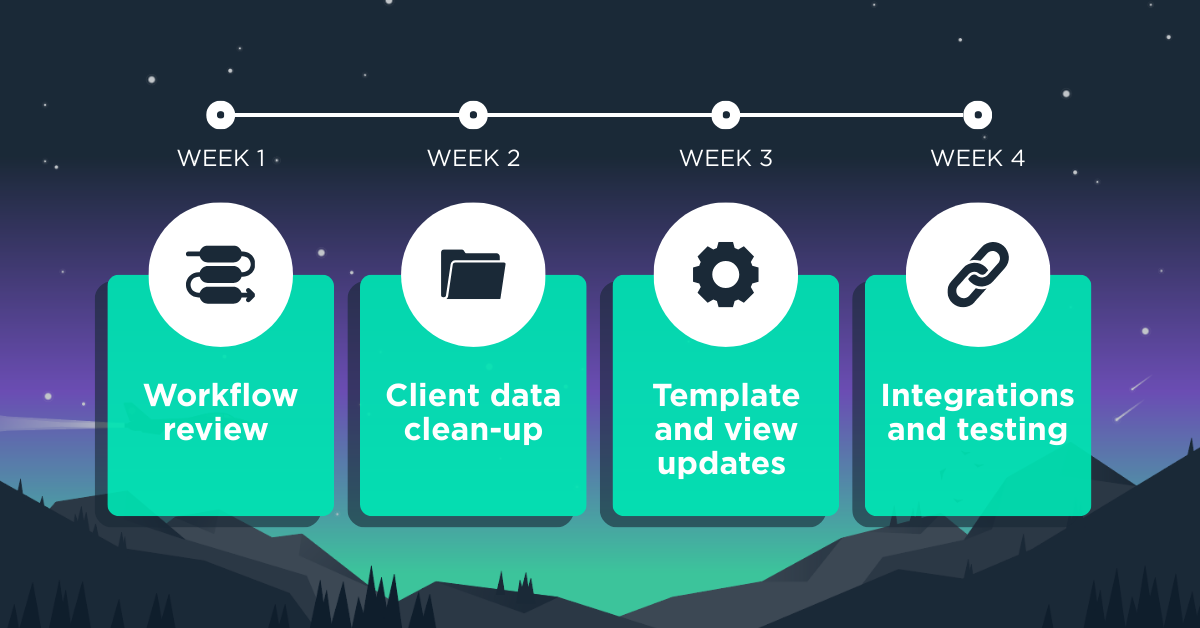
Rebuilding your systems does not need to be complex. A one month plan is enough to create meaningful change.
Week 1: Review current workflows
Identify bottlenecks, duplicate steps, unclear responsibilities, and processes that rely too heavily on memory. Map the ideal version of each workflow.
Week 2: Clean up client data
Update registers, tidy communication trails, correct inconsistencies, and align information across systems. Clean data is the foundation of every improvement that follows.
Week 3: Update templates and views
Refresh task templates, email templates, document naming conventions, and internal instructions. Adopt shared views inside AccountKit that improve visibility.
Week 4: Implement integrations and test improved flow
Connect your document management system, practice tools, e-signing apps, and any other systems that your workflow depends on. Test the end to end flow in AccountKit and refine where needed.
These four weeks create a clear, connected, repeatable system that supports your team long after January has passed.
Start the Year With Intention
Rebuilding your systems is not about creating more work for yourself in January. It is about giving your team the foundation they need for the rest of the year. When your workflows are documented, your tools are connected and your client information sits in one place, the day to day feels lighter. Reviews become cleaner. Deadlines feel more predictable. Small improvements compound into a sense of control that carries through every quarter.
January offers a rare pause in the cycle, and using that window well changes everything that follows. Whether you start with one workflow, one integration or one clean up, the impact builds quickly. The firms that commit to this early in the year are the ones who see the clearest benefits later.
If you want to begin the year with clarity and a structure that supports your team, the simplest first step is to see how AccountKit can unify your workflow. A 14 day free trial gives you the space to explore the tools, test your processes, and experience what a more connected practice system feels like.
Share this

5 ways to increase your productivity using Excel
.png?width=1200&height=628&name=AccountKit%E2%80%99s%20New%20Tools%20Save%20You%20Time%20and%20Clicks%20(1).png)
AccountKit’s New Tools Save You Time and Clicks